AI Product Design
0→1 Product
Interaction Design
Creator Tools
CueOver
Creating an AI-powered streaming experience that brings live audience conversations into the stream.


Industry
Creator Technology / AI / Streaming
Role
Founder
Product Designer
Timeline
2+ months (Ongoing)
Streamers are constantly trying to engage with their audience while simultaneously playing games, talking to viewers and managing their broadcast. Twitch chat is an important part of that interaction, but reading and responding to messages creates a constant attention gap between the streamer and their audience.
I wanted to explore how AI could close that gap. Not by replacing the streamer’s interaction with chat, but by helping the right audience moments become part of the stream itself.
I designed and built CueOver, an AI-powered streaming tool that listens to a streamer's voice, understands what they're responding to and matches it against live Twitch chat in real time. When a match is detected, the relevant message is surfaced as an animated on-stream alert through OBS.
The experience combines real-time speech recognition, voice matching, chat analysis and configurable visual alerts into a simple workflow for streamers. I designed the product end-to-end, from the initial concept and interaction model through the web experience, desktop application, overlay system, onboarding, account experience and visual identity.


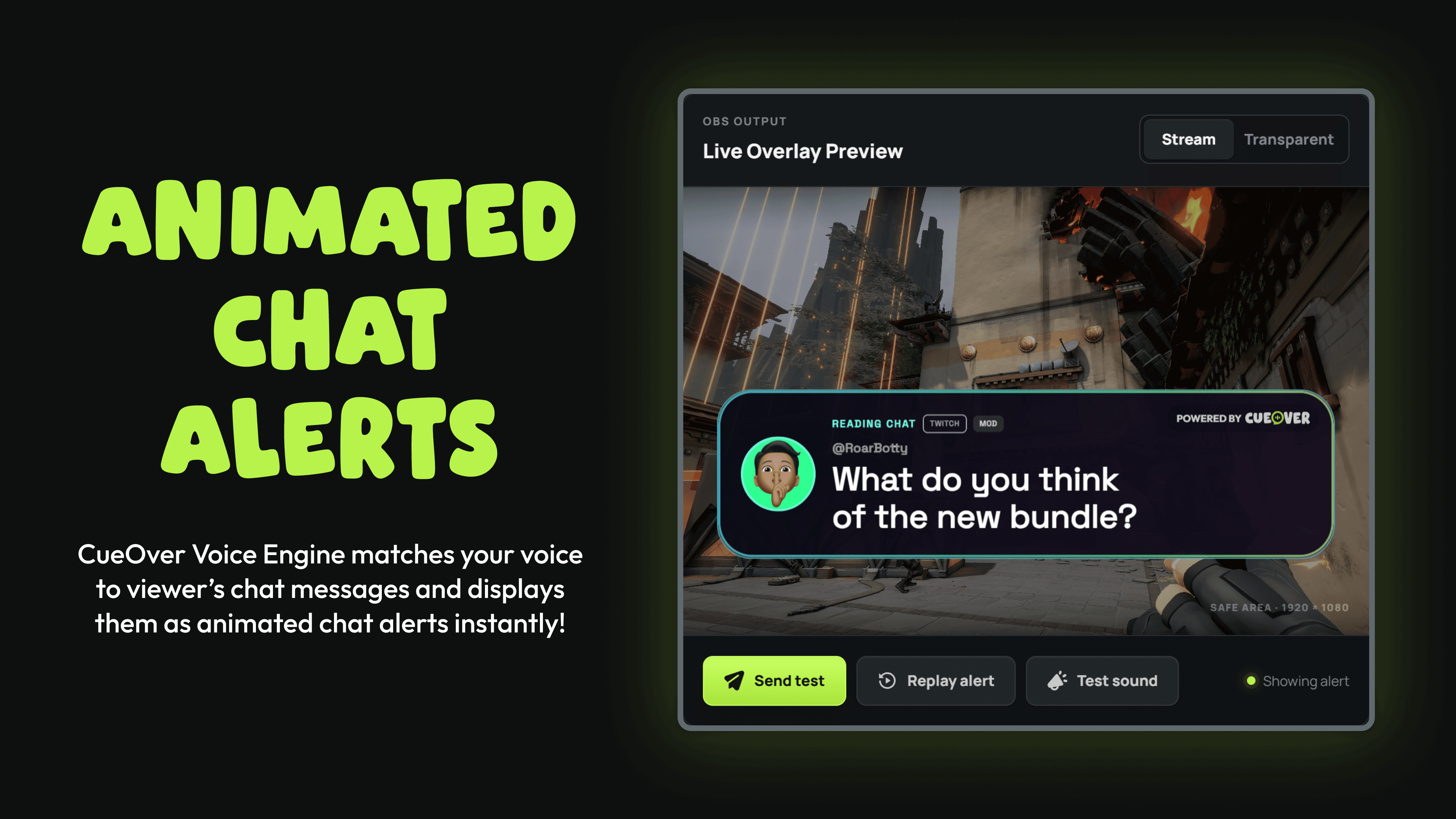
CueOver evolved from an early product concept into a working AI-powered streaming product, with a complete experience spanning the streamer dashboard, live studio, voice engine, Twitch integration and OBS overlay.
The project also became an opportunity to explore how AI can move beyond traditional chatbots and recommendations to create real-time, context-aware interactions between people and their audiences.

Let's dig deeper.
Turning chat into part of the show
Streamers constantly move between their game, their audience and the conversation happening in chat.
But when a streamer reads a message aloud, viewers often have no idea which message they're responding to.
I saw an opportunity to turn that moment of interaction into part of the stream itself.
What began as a product idea became an opportunity to explore a different way of working as a product designer by combining product strategy, design, prototyping, development and AI into one continuous process.

Building With AI
I utilise AI throughout my current product design workflow rather than simply as a development tool. It helps me with research, PRDs, user flows, brainstorming, edge cases, prototyping and implementation.
I refine the visual design and interaction details before feeding those decisions back into the product.
Figma → Codex → Product → Figma → Codex → Product

Figma
Product design and visual refinement

Codex
Product exploration, development and iteration.

GitHub
Version control and collaboration

Supabase
Authentication, database and backend services

Resend
Transactional emails

Netlify
Deployment and hosting

Cloudflare
Infrastructure and delivery
From Designer to Builder
When you're responsible for getting something working, you start thinking beyond the screen.
How does this actually behave?
What does it connect to?
What technology makes this possible?
Where will it break?
What constraints will shape the experience?
Understanding those questions earlier makes the design stronger, I'm able to explore feasibility alongside the experience and make more informed product decisions.
Prototype early. Question assumptions. Commit deliberately.
The Core Experience
The product is built around a real-time voice-to-chat matching loop.
1. Connect
Link your Twitch channel and chat.
2. Listen
CueOver listens to the streamer's microphone while they talk.
3. Understand
Speech is transcribed in real time.
4. Match
CueOver compares the transcript against recent chat messages.
5. Trigger
When a match reaches the required confidence, the corresponding message becomes an alert.
6. Show
The alert appears in the stream through an OBS Browser Source.
The complexity happens behind the scenes.
The streamer's experience should feel almost effortless.

Mapping the Experience
Each step introduced its own product questions.
What happens when the match isn't confident?
What happens when two messages are similar?
How quickly does the alert need to appear?
What happens when speech recognition gets something wrong?
What does the streamer see while the system is listening?
Mapping these scenarios early helped turn a simple concept into a product that could operate in the messy reality of a live stream.
Designing the Live Studio

Designing the Alert Experience


Proving Value Before Monetising
